

Charging electric trucks and construction equipment: how much power does your site really need?
When you operate electric trucks or electric construction equipment, it is easy to start by thinking about chargers, grid connection capacity and grid congestion. But that is not the best starting point.
Start with the daily operation. Which routes do the trucks need to drive? How many hours does a machine operate on the construction site? When is equipment idle, and when does it need to be available again?
Only then should you determine how much energy and charging power are actually required.
The first question is not: how much power do I need?
The first question is: how much energy needs to be charged into each vehicle or machine, and how much time is available to do so?
For a transport company, this information mainly comes from route planning and vehicle downtime. For a construction company, it comes from operating hours, deployment patterns, shift schedules and available charging moments on or away from the construction site.
- How many kilometres does each vehicle drive per day?
- How many hours does each machine operate?
- When does the vehicle or equipment become available for charging?
- When does it need to depart or be ready for use again?
- Which vehicles and machines need to charge at the same time?
- How will this deployment change over the next three or six years?
Using these data, you first determine the energy demand and available charging time. From there, you calculate the simultaneous power demand, compare it with the available grid capacity and then design the charging site or temporary energy supply.
The sequence is therefore simple: operation first, technology second.
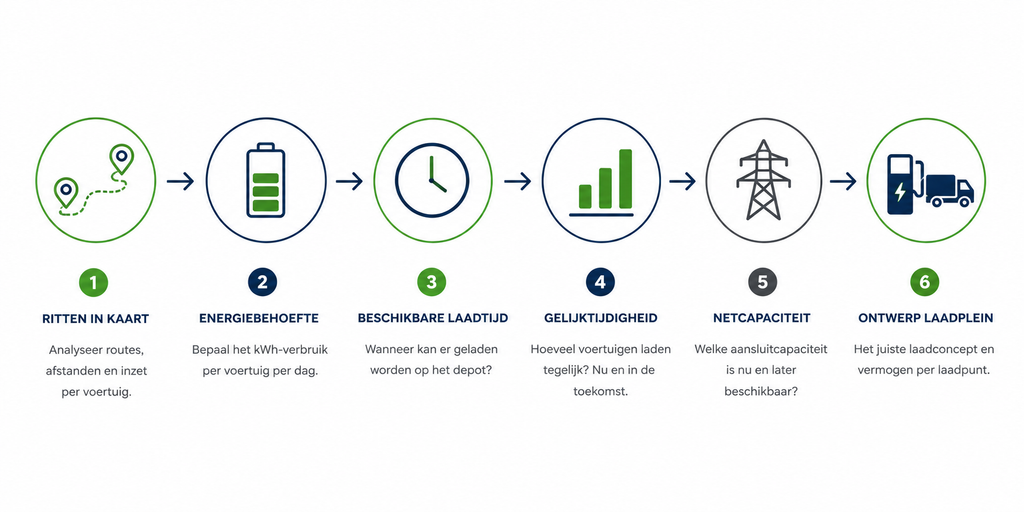
From operation to charging solution in eight steps
An initial analysis does not need to start with a complicated model. First map what the vehicles and machines actually need to do. Then translate that step by step into energy, power and technology.
- Map routes, operating hours and deployment.
- Determine energy consumption for each vehicle or machine group.
- Map arrival times, departure times, breaks and downtime.
- Determine how much energy is required within each charging window.
- Calculate the simultaneous charging power requirement.
- Compare this demand with the grid capacity that is actually available.
- Compare several technical scenarios.
- Only then determine charging points, power distribution, storage and any mobile energy solutions.
We use the same sequence in our quick scans, designs and market enquiries for companies. This creates a substantiated choice before you invest in charging technology.
From use to kWh per day
For trucks, the first calculation is usually based on distance and average energy consumption. For construction equipment, operating hours and consumption during the actual duty cycle are more relevant.
For a truck, for example:
daily distance × energy consumption per kilometre = daily energy use
A tractor unit that drives 240 kilometres per day and consumes an average of 1.6 kWh per kilometre uses approximately 384 kWh per working day.
The same principle applies to construction equipment, but the calculation should reflect actual use. A machine that operates under heavy load for only part of the day has a different energy profile from a machine running continuously at maximum output.
The charging window determines the required power
The same amount of energy can be charged at very different power levels. A truck that remains at the depot for ten hours can charge relatively slowly. A vehicle that needs to leave again after two hours requires much more power.
The same applies on a construction site. Some machines can charge throughout the night, while other projects require opportunity charging during breaks or shift changes.
This is why battery capacity alone tells you little about the charging power you actually need.
Simultaneous charging determines the peak
Having ten trucks on site does not automatically mean that ten trucks need to charge at maximum power at the same time. One may leave at 04:00, while another does not depart until 07:00. Some vehicles return almost empty, while others still have sufficient energy remaining.
By spreading charging sessions and distributing the available power across vehicles, the required peak can be reduced. This can directly affect the required grid connection and the investment in charging infrastructure.
For construction equipment, the principle is similar, but deployment is often less predictable. An excavator may be required all day, while a mobile elevating work platform or telehandler may be idle regularly. This is why you assess each machine group separately to determine when charging is actually possible.
An energy management system can then distribute the available power across the charging points. The technology supports the process; vehicle and machine planning remains the starting point.
A practical example with ten trucks
Assume a transport company operates ten electric tractor units. Each truck drives an average of 240 kilometres and uses approximately 384 kWh for that route.
The total daily energy demand is approximately 3,840 kWh. If all vehicles remain stationary for around ten hours after their shift, an average of roughly 384 kW would theoretically be sufficient to replenish that energy.
In practice, you also need to account for charging losses, planning, power distribution and vehicles that arrive later or depart earlier.
The charging profile is equally important: not only how many kWh are required per day, but also when that power is needed. Two depots with the same daily energy demand can therefore require very different grid connections and charging layouts.
This shows immediately why ten trucks do not automatically require ten high-power fast chargers.
Depot charging and construction-site charging require different approaches
In transport operations, charging is usually linked to a fixed location. Vehicles return to the depot, often remain stationary for longer periods and charge through a fixed grid connection.
For construction equipment, the location, deployment pattern and available charging moments vary much more. One machine may be able to charge overnight, while another needs additional charging during a break or shift change.
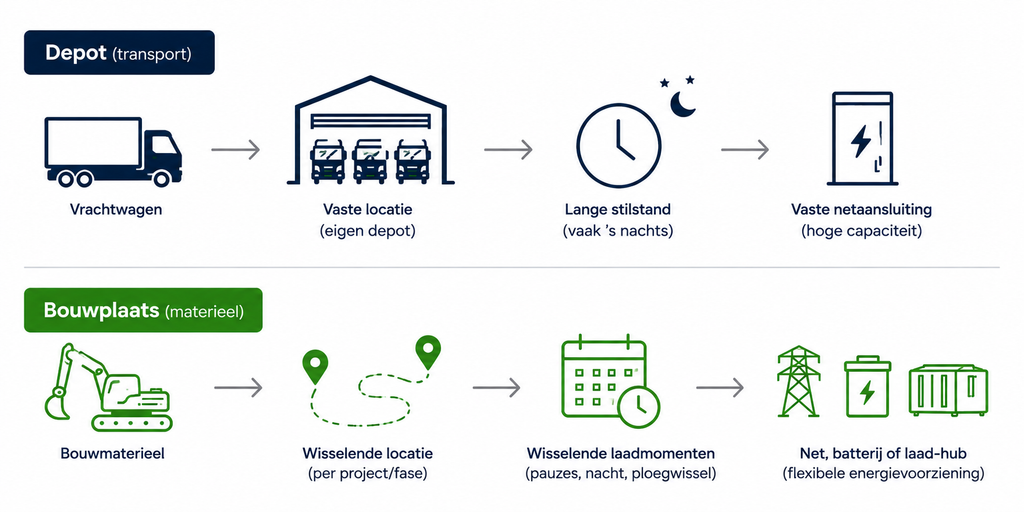
The same energy demand can therefore lead to a different technical solution. On a construction site, the energy supply may combine a grid connection, mobile battery, charging container or external charging hub.
The sequence remains the same: first determine what the operation requires, then decide how that energy should be made available.
Averages are not enough
A transport depot or construction site does not operate the same way every day. Distances change, machines operate longer and vehicles may return later than planned.
Do not base the design on an average day alone. Work with several scenarios, for example normal use, peak use and future growth.
Grid capacity comes afterwards
Only when energy demand, charging windows and simultaneous charging are known can you compare the resulting power demand with the available grid connection.
This shows whether the existing connection is sufficient, whether controlled charging is needed or whether additional measures should be investigated.
Do not look only at the contracted connection capacity. A 1 MW connection, for example, does not mean that 1 MW is freely available for charging. Workshops, refrigeration, offices, production equipment and other installations use the same connection. You therefore need to look at the actual load profile.
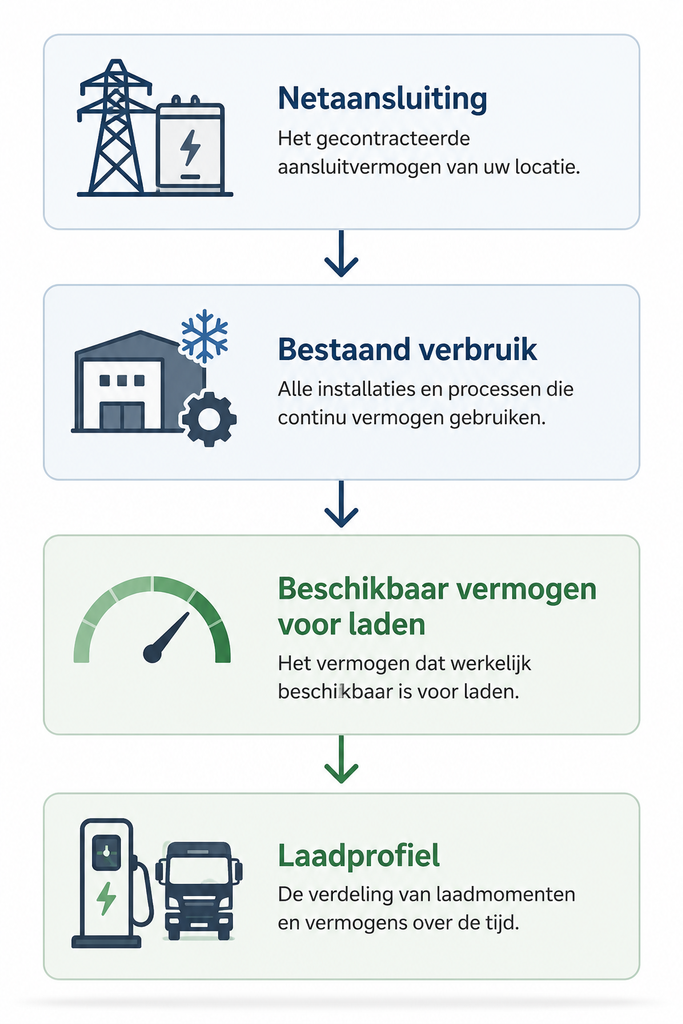
A fully utilised grid connection does not automatically mean that electrification has to stop. First determine how much of the existing capacity is actually available when vehicles or machines need to charge. You can then compare scenarios involving controlled charging, battery storage, local generation or a different distribution of charging moments.
Suppose your charging profile requires 700 kW at a peak moment, while only 400 kW is available at that time. You then do not have an abstract grid problem, but a concrete shortfall of 300 kW. The next step is to determine whether that difference should be addressed through planning, control, storage or additional grid capacity.
From analysis to a technical choice
Once routes, operating hours, charging windows and grid capacity are known, you can compare scenarios side by side. This means comparing not only technology, but also capital expenditure, operating costs, expandability and consequences for the daily operation.
At a transport depot, for example, you may compare more charging points at lower power with fewer charging points at higher power. On a construction site, you may compare a temporary grid connection, battery storage, a charging container or charging via an external hub.
The client ultimately decides which scenario fits best. Green Fellows can develop this further into a concept design, market enquiry and supplier selection.
What should you collect for an initial quick scan?
- number of vehicles and machines
- vehicle types and types of equipment
- daily distances or operating hours
- arrival and departure times
- available charging moments
- special operating conditions such as refrigeration, heavy loads or intensive duty cycles
- current grid connection and existing electricity consumption
- expected growth over the next few years
Consider the investment as well as the technology
A technically feasible charging site is not automatically the best investment. For each scenario, compare both capital expenditure and annual operating costs, including the grid connection, charging equipment, energy storage, maintenance, management and any software.
For transport companies, it is also important to look beyond the purchase price of chargers and consider the total charging cost per kWh and per vehicle. In the article What e-truck charging really costs in practice at a depot, we examine these costs in more detail.
This provides not only an answer to whether electrification is feasible, but also which scenario best fits the operation and which investment decision follows from it. The same substantiation can also support discussions with management, shareholders, banks or other financiers.
Do you want to know what this means for your site?
Green Fellows carries out quick scans for transport and construction companies that want to understand how much energy and charging power their electric vehicles or machines require.
We assess the current operation, expected growth and several technical scenarios. The result provides a substantiated basis for investment, design, permits, financing and a market enquiry.
See also our charging and energy infrastructure projects, or read more about our services for transport and construction companies. If you would like to discuss your own site or project, please contact us.